Background
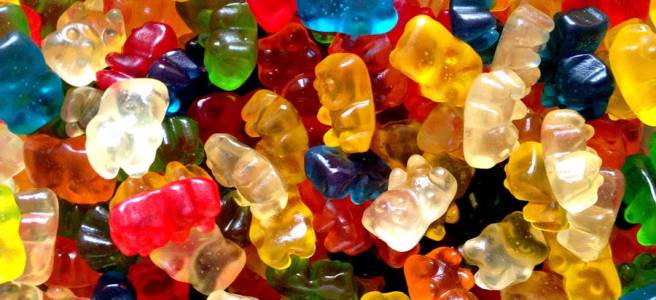
Gummy sweet is a distinct sweet made up of gelatin, colorings, flavorings, and sweeteners. Making it one of the most flexible confection items ever due to the fact that of its nature it can be formed into actually thousands of shapes. First established in Germany in the early 1900s, it got terrific appeal in the United States throughout the 1980s. Today, it continues to be popular, with sales amounting to over $135 million in 1996 in the United States alone.
History
Gummy sweet represents a more current advance in sweet innovation. The innovation, stemmed from early pectin and starch formulas, was very first established in Germany in the early l900s by a guy called Hans Riegel. He started the Haribo business, that made the very first gummy bears in the 1920s. While gummy sweet has actually been produced because this time, it had actually restricted around the world circulation till the early 1980s. When Haribo started producing gummy bears in the United States, it was then. The trend captured on, triggering other business to establish comparable items. The gummy bears resulted in other kinds of gummy sweet entries from business such as Hershey, Brach’s, and Farley’s. Now, the sweet is readily available in numerous different types, from dinosaurs to fruit rolls. According to one gelatin producer, almost half of all gelatin made around the world presently goes to making gummy sweets.
Raw Materials
Gummy sweet dishes are normally established by knowledgeable food technologists and chemists. By mixing together various active ingredients, they can manage the numerous attributes of gummy sweet, such as taste, texture, and look. The main components consist of water, gelatin, tastes, sweeteners, and colors.
The primary active ingredient accountable for the sweet’s distinct, gummy qualities is gelatin. When put in water, this is a protein obtained from animal tissue that forms thick services or gels. When utilized at a proper concentration, the gels handle the texture of the chewy, gummy sweet. Nevertheless, given that these gels are thermoreversible, which indicates they get thinner as they are heated, gummy sweets have a “melt in the mouth” attribute. Both the texture and the quantity of time it takes the sweet to liquify in the mouth can be managed by the quantity of gelatin utilized in a dish.
Since gelatin is a odor-free and unsavory substance which contains no fat, flavorings and sweeteners are contributed to offer gummy sweet its taste. Different sugars are included as sweeteners. Sucrose, stemmed from beets or sugar walking cane, supplies a high degree of sweet taste to the gummy sweet. Fructose, which is considerably sweeter than typical sucrose, is another sugar that is typically utilized. Since it assists avoid the other sugars from destroying the gummy and taking shape texture, corn syrup is likewise utilized. Likewise, corn syrup assists include body to the sweet, preserve wetness, and keep expenses lower. Another sweetener is sorbitol, which has actually the included advantage of assisting the sweet keep its wetness material. In addition to taste, a few of these sweeteners have actually the included advantage of protecting the gummy sweet from microbial development.
The sweet taste of gummy sweet is just one of its attributes. Natural and synthetic tastes are likewise utilized to produce a special taste. Natural tastes are acquired from fruits, berries, honey, molasses, and maple sugar. The effect of these tastes can be enhanced by the addition of synthetic tastes that are mixes of fragrant chemicals and consist of products such as methyl anthranilate and ethyl caproate. Likewise, acids such as citric acid, lactic acid, and malic acid are contributed to supply taste.
Gelatin gels have a natural faint yellow color, so dyes are contributed to produce the broad range of colors discovered in gummy sweet. Normal dyes consist of Red color # 40, Yellow color # 5, Yellow color # 6, and Blue color # 1. Utilizing these federally managed dyes, gummy producers can make the sweet nearly any color they prefer.
The textural qualities of gelatin gels depends upon numerous elements, such as temperature level, approach of manufacture, and pH. While the production technique and temperature level can be physically managed, the pH is managed chemically by the addition of acids. These consist of food grade acids such as citric acid, lactic acid, fumaric acid, and malic acid. Other components are included throughout the production procedure as flavorants, lubricating representatives, and shine improving representatives. These consist of products like beeswax, coconut oil, carnauba wax, mineral oil, partly hydrogenated soybean oil, pear concentrate, and confectioner’s glaze, which are typically included throughout the filling stage of manufacture.

 Basic Herbs and Spices